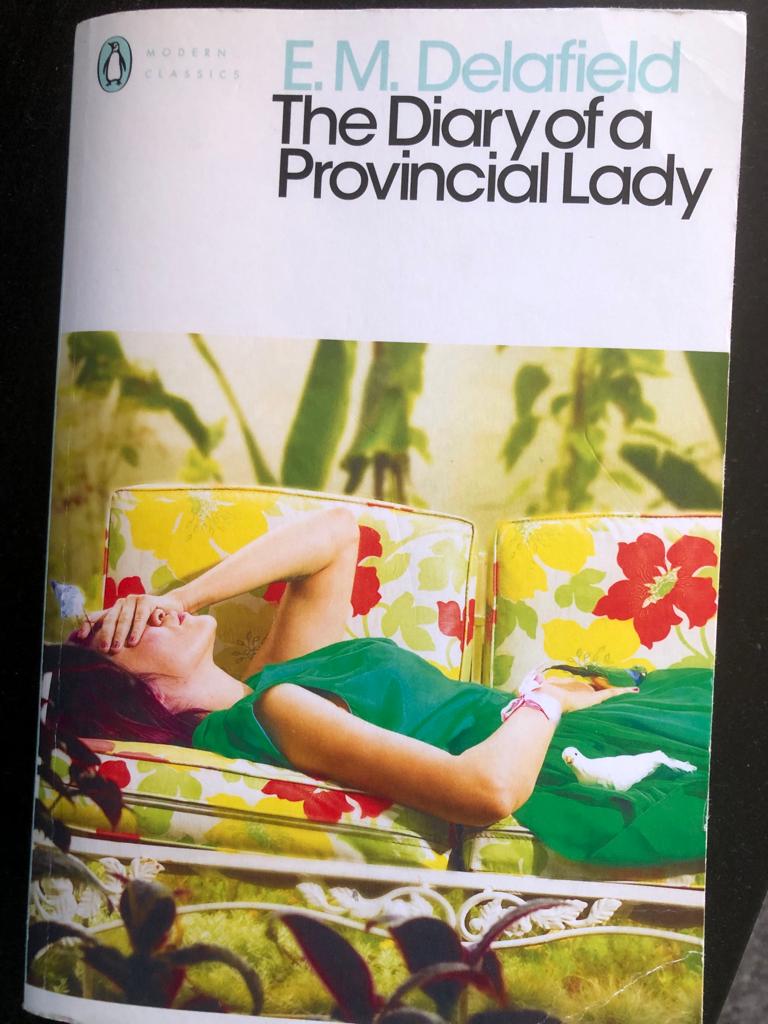
The Diary of a Provincial Lady has become my unexpected favourite book of the year. Its unassuming and self-deprecating title very much sets the tone for the four parts of E.M. Delafield’s semi-autobiographical novel, as the main character from a small village in Devon embarks on a successful literary career that takes her first to London and later to America. As she is introduced into literary circles and meets editors, publishers, fellow writers and their hangers-on, the reader experiences early twentieth-century society through the eyes of a woman who quickly sees through the facades of wealth and education.
The first part, The Diary of a Provincial Lady, focuses on the life of the unnanmed protagonist who lives a reasonably comfortable life with her husband and two young children in Devon, dividing her days between running the household and its servants on a tight budget, talks at the Women’s Institute and organising village fêtes. Alongside, managing the education of her children, the emotional outbursts of their French governess and the demands of Cook, and discussing village matters with Our Vicar’s Wife, the protagonist also contributes to magazines, such as Time and Tide and sees in every odd instance ideas for articles which for the most part never materialise.
While the Provincial Lady is restless, she never seems really dissatisfied with her lot, maybe because she keeps finding ways to occasionally break out of her routine. It is rare that we catch her – to the dismay of her husband Robert, the father of her children – exclaiming at breakfast ‘that the most wonderful thing in the world must be to be a childless widow!’
In The Provincial Lady Goes Further, her husband Robert watches her growing literary ambitions with quiet admiration and grumblingly assents as she takes a small flat in London to write and explore the city’s social life with her well-connected friend Rose. While feminism is much on the protagonist’s mind, however, she praticises rather than preaches it, making a living as an author and attending late-night parties (without her husband) while never forgetting about her children’s need for toothpaste and new winter vests.
If I had to describe Delafield’s style in one sentence, I would characterise it as a light-hearted version of Virginia Woolf and the Provincial Lady as a funny and acerbic Mrs Dalloway. She has a very similar perceptiveness expressed in a permanent interior monologue which is brought to the page in the form of brief diary entries. Yet, where Mrs Dalloway’s stream of consciousness is full of regret for missed opportunies and lost love, and despair in the aftermath of World War I, for the Provincial Lady there are few situations in life that cannot be improved by the purchase of a new hat. It is no surprise then that the protagonist of Delafield’s novel has little time for Woolf’s writing, which she considers largely pretentious and inaccessible. The same could not be said for Delafield.
Even though the parts of the novel are set between the wars and the privileged upper middle-class life Delafield describes has long gone, her writing feels remarkably fresh and relatable, as the characters of her books are recognisable types: a rich and boastful Lady B. who thrives on making others feel small; a well-intentioned Vicar’s Wife who can’t help feeling responsible for everyone in the village, or pretentious fellow writers who claim an intellectual high ground, while never really producing very much at all.
Meanwhile, as the protagonist celebrates modest literary successes and pay cheques that help clear the ever-growing overdraft, we see The Provincial Lady in America, charming readers across the pond with her wit and her quaint English ways, as she travels from lecture to lecture. While we do not learn much about the nature of her writing, however, the provincial lady informs us that everything in America seems superior to England – the trains, the houses, the food. Nevertheless, she is overcome by emotion each time she thinks of her husband and children, and wondering what Our Vicar’s Wife might do in her situation. Even while on the other side of the world, village life in Devon always remains at the centre of her expanding universe.
The final part, The Provincial Lady in War-Time, then takes us through to the beginning of World War II and our protagonist’s search for meaningful work in the face of national calamity. As her chilren are grown up and away at school, she takes in some evacuees at her house in Devon, but keeps longing for more meaningful work in the service of her country as England is threatened by air raids from Hitler’s troops. Leaving Devon for London in the hope of offering her literary skills to the Ministry of Information, she ends up working in an ARP canteen at night without a word of complaint, while hosting sherry parties to boost the morale of her friends and fellow workers. However dark the blackout and however threatening the situation, the protagonist refuses to be defeated either by Hitler or by life.
It is this stoic attitude towards life I find so appealing about Delafield’s novels. The Provincial Lady always makes the best of any situation and reflects back on the absurdities of life with a good deal of self-irony and little sentimentality. It can teach us a lot.
gm
*
E.M. Delafield, The Diary of a Provincial Lady (Penguin Books, 2014).

 The History Woman's Blog