Over the past couple of years I have become rather obsessed with the translation of political thought. As I am wrapping up my Marie Sklodowska-Curie fellowship project on ‘English republican ideas and translation networks in early modern Germany, c1640-1848’ a select group of friends and colleagues joined me at the German Historical Institute in London last week to discuss some of the broader issues.
For my project, I have looked among others at the translation of English republican texts by authors such as John Milton, Marchamont Nedham, Edmund Ludlow, Algernon Sidney, Robert Molesworth and John Toland from English into German and, importantly (!), other relevant languages, studying their political thought, but also trying to find out more about the individuals doing the translations as well as about the networks that facilitated the production and distribution of those texts.
Direct translations into German were rare
Direct translations from English into German were relatively rare in the earlier part of the period, as were professional translators. Most of the translators we are dealing with before translation became more professionalised in the eighteenth century were scholars, jurists, officials or other political writers with a personal interest in the subject or the political cause, sometimes writing for an employer or patron.
What I find most interesting about the subject, however, is the multilingual aspect. Some of the earlier texts, like Milton’s Defensio pro Populo Anglicano (1651), which justified the regicide of Charles I to a horrified continental Europe, did not need to be translated to circulate internationally, and circulated widely in Latin, sometimes clandestinely.
Publishing networks were key
Other texts, like Algernon Sidney’s Discourses concerning Government, circulated in French long before they were translated into German. Edmund Ludlow’s Memoirs was available in French and Dutch, but was not translated into German at all.
Key to both the translation and wider distribution of English republican works were networks of authors, translators and bookseller-publishers, many of them located in the Netherlands, from where works then travelled into Germany.
There was usually a reason or a purpose behind the translation of a political text, and the translation itself might be rather different from its original in a number of ways – either because the translator needed to adapt it for their target audience, or because they wanted to steer the reception of the text into a particular direction.
Concepts could be misunderstood
Sometimes, texts were moderated, controversial or dangerous passages were taken out or reinterpreted, or material was added to make a text more relevant to a specific time, audience or purpose. Sometimes concepts were misunderstood.
This did not only happen when translating from one vernacular into another. Translations from the Latin also offered room for interpretation. Mark Hutchinson (Gloucestershire) offered a rather playful paper on ‘German and English (mis)translations of “Stände” and “estates” in the seventeenth century’, demonstrating how a translator’s choices could significantly alter the meaning of a text. Thus, the Latin ‘status’ could be translated as ‘estates’ or ‘states’ in English, or as ‘Stände’ in German. The English ‘state’, translated into German, meanwhile, could signify ‘Zustand’ or ‘Verfassung’, introducing something rather new and different.
Translators often remained anonymous
While translators often had considerable influence on the way in which a text was understood and received, many of them remained anonymous. Thus, we do not know with any certainty who first translated John Locke’s Two Treatises of Government (1689) into German. Felix Waldmann (Cambridge) talked about ‘Ephraim Gerhard and Locke’s Two Treatises’, probing Martin Mulsow’s ascription of the first German translation of Locke’s text to Gerhard on the basis of contextual evidence. Arguing that the ascription of the translation to ‘G.’ in the tract itself was rather slim evidence, Felix used Gerhard’s other publications, such as his Einleitung zur Staatslehre (1713), to question whether Gerhard was necessarily the only or even most likely candidate.
The need for re-translation
Peter Schroeder (UCL) offered a paper on ‘Translating Filmer and Hobbes’, based on his own experience of editing German translations of seventeenth-century English political texts for a modern audience. Peter addressed among others the important question of how well translations age and whether there might be a need for regular adjustments or even re-translations to ensure that a work can be understood. In fact, the subsequent discussion turned on the question whether even historical texts written in our own mother tongue need translating, as language keeps evolving and the meaning of words and concepts changes over time.
We also discussed the question whether there is such a thing as a ‘faithful’ translation and what this might entail. Many translators in the seventeenth and eighteenth century were clearly convinced that they needed to rewrite their sources to bring out their ‘true’ meaning more clearly.
Translating history as political thought
Giovanni Lista (CEU, Vienna) appropriately addressed the transformative properties of translations, highlighting translation as a creative act, and the role of translators as authors as well as ideological gatekeepers. In his paper on ‘Translating Political Thought through Historiography: Robert Watson’s History of Philip II in German (1778-1782)’, Giovanni highlighted in particular the way in which Watson as a Protestant translator handled his Catholic sources. Accusing ‘popish’ historians of not giving ‘true’ accounts of the events, Watson rather highlighted the struggle of European Protestants against Philip II’s tyranny, giving the history a distinctly republican focus.
Capturing the spirit
Elias Buchetmann (Rostock) addressed the growing interest in Germany in the English constitution following the translation of relevant works by William Blackstone and Jean-Louis de Lolme. In his paper, ‘Interpreting the English Constitution for a German Audience: Translation as Political Practice in Early Nineteenth-Century Kiel’, Elias argued that nineteenth-century constitutional reformers in northern Germany studied the English constitution with great interest. Understanding that the English constitution was historically grown, however, and could not simply be transposed to Germany, they aimed to adapt its principles for a German context in an attempt to reclaim a lost Germanic liberty.
The influence of bridging languages
Katalin Straner (York St John/ Newcastle) addressed the politics behind scientific translations in later nineteenth-century Hungary in her paper ’Authorship, agency, adaptation? Hungarian translators of English scientific literature and the role of German, 1850s-1870s’. Arguing that smaller language groups had a tendency to lean on more dominant bridging languages, she showed how translations of Charles Darwin’s works from English into Hungarian were mediated through German. Nevertheless, Hungarian scientists and science translators also aimed to create something new and independent from their sources.
So what did we learn?
I certainly learnt that there are multiple different approaches to the history of translation, and that in focusing on political ideas we should not dismiss the language in which they are expressed.
For my part, I think that a growing interest in translation is one of the more positive developments associated with globalisation. It contributes to the rise of transnational and global historical approaches, which rely to a large extent on translation and on historians with the necessary linguistic skills to rise to the challenge. So I think there is a lot more interesting work to be done out there.
gm
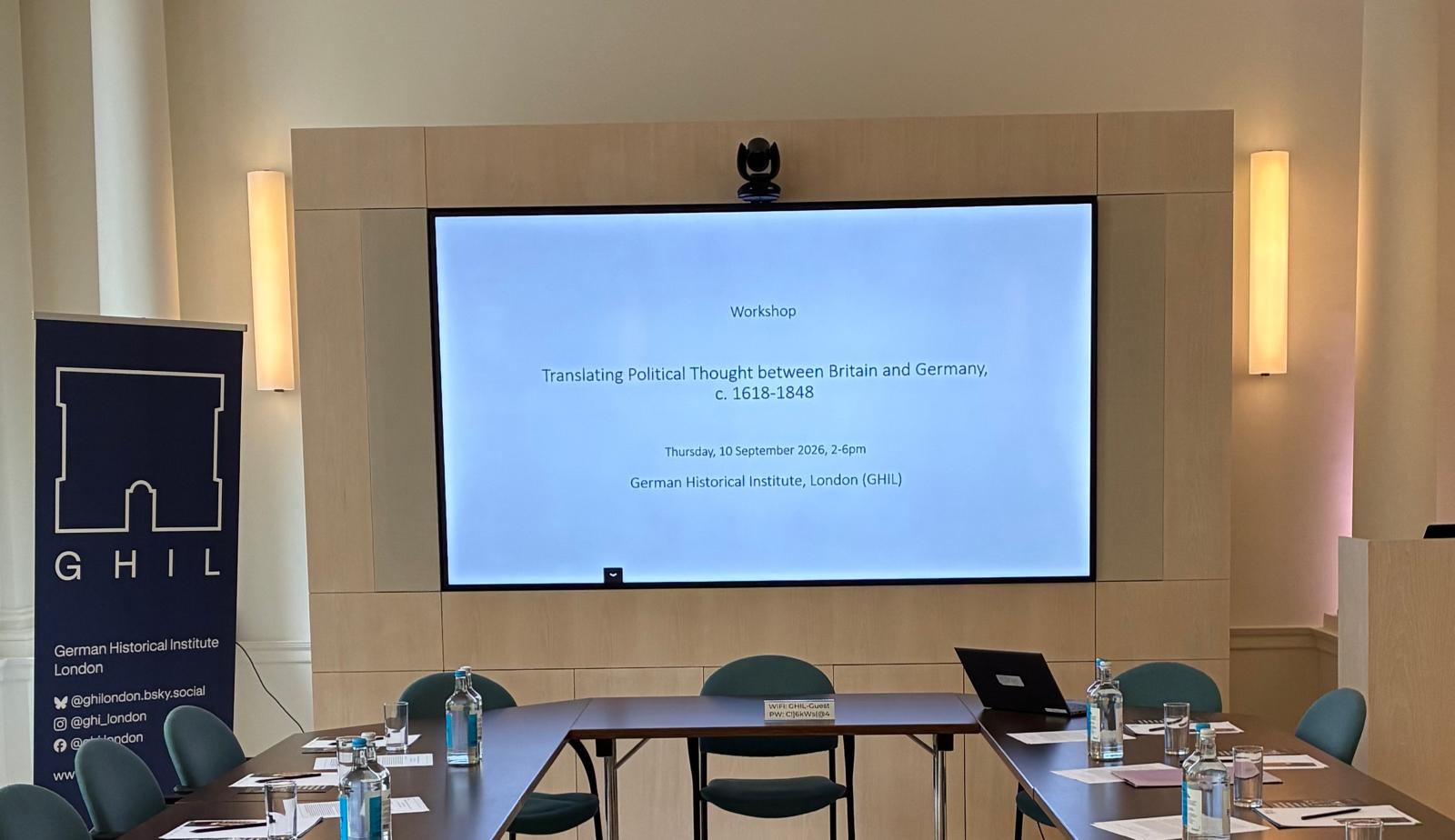
The seminar room at the German Historical Institute before the workshop. (Foto: Mahlberg)


